
Send Us A Message
How to tell whether insecticides resistance is causing control failure
Sometimes a treatment looks correct on paper and still fails in the field. The rate was followed, the timing seemed reasonable, the equipment was working, and yet the pest population comes back as if nothing happened. That situation is frustrating because the next step is not always obvious. Many people first suspect a weak batch, bad weather, or a simple application mistake. Those can absolutely be the cause, but not every repeat failure comes from the product or the operator.
One of the harder possibilities to recognize is resistance. It tends to show up quietly. At first, control seems slightly less reliable. Then a treatment that used to suppress a population no longer gives the same result, even when the same active ingredient is applied again. If you are trying to decide whether insecticides resistance is behind a control failure, the key is not to jump to that conclusion too fast, but also not to ignore the warning signs. A careful process helps separate resistance from other causes and prevents repeated applications that waste time, raise costs, and increase exposure without improving control.
When a failure is probably not resistance
Before treating resistance as the main explanation, it helps to look at the common reasons control breaks down. In practice, many failures start with coverage, timing, or pest identification problems. A spray can miss the actual hiding places. The target pest may be in a life stage less affected by the chosen chemistry. Rain, heat, sunlight, alkaline water, or poor tank mixing may reduce performance. Sometimes the pest was not the species originally assumed, and the product choice was weak from the start.
That matters because resistance is a population-level issue. It means a meaningful portion of the target population can survive exposure that used to control it. If the product was never delivered properly, resistance cannot be diagnosed from that result alone. The first job is to ask whether the treatment had a fair chance to work.
A useful way to think about it is this: if one application fails once under questionable conditions, resistance is only one possibility. If similar applications fail repeatedly under conditions that used to work, then resistance moves much higher on the list.
The field signs that should make you suspicious
There is rarely one dramatic signal. More often, a pattern develops.
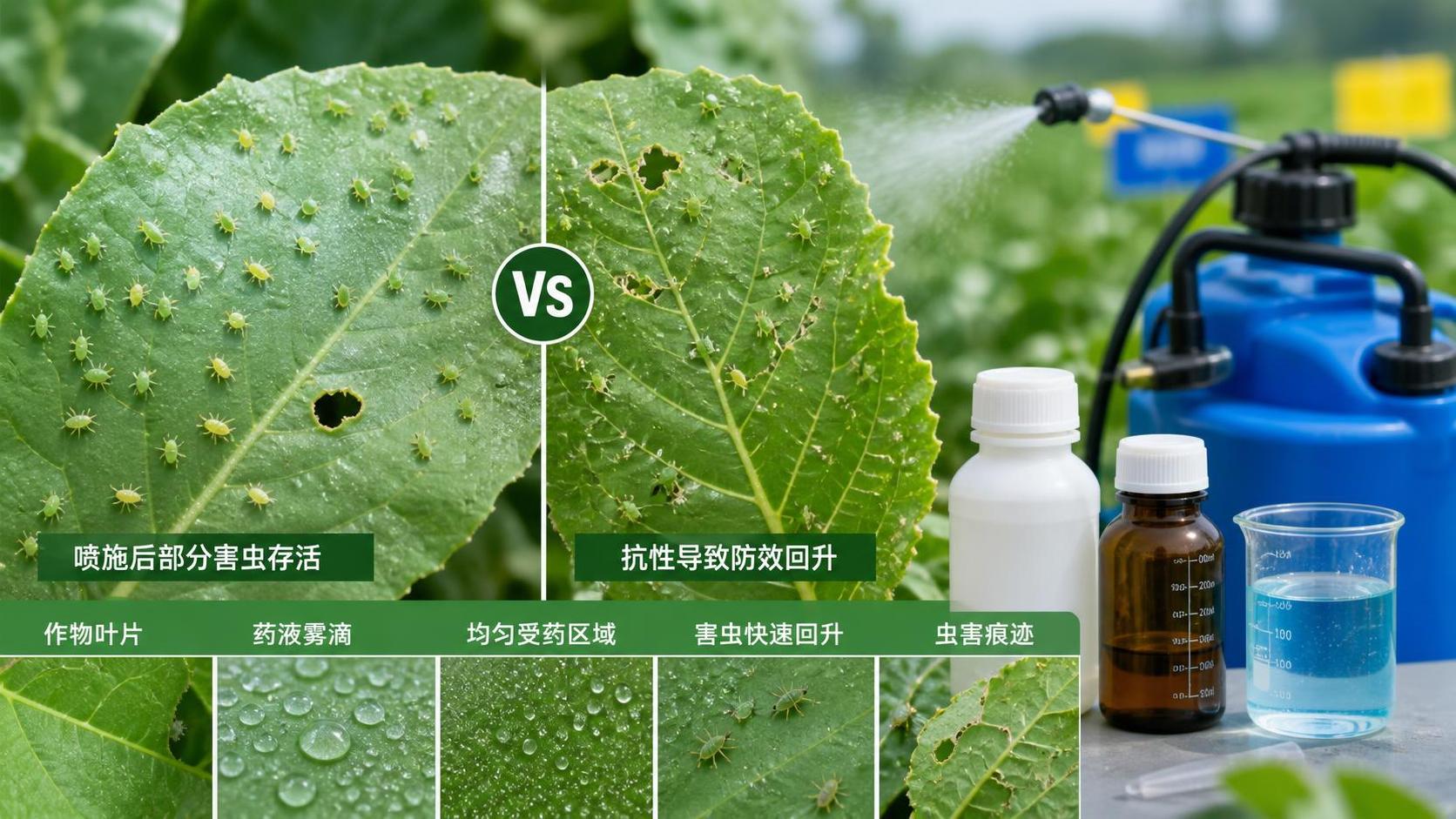
A common sign is uneven survival. After treatment, you may see many affected insects but also a noticeable group that remains active and healthy in areas that clearly received exposure. Another sign is shortened control duration. The initial knockdown may look acceptable, yet the population rebounds unusually fast. In some situations, repeated use of the same mode of action leads to weaker results each cycle, even though the application process stays mostly unchanged.
You should also pay attention when neighboring sites or different areas with similar conditions respond differently. If one location still gets acceptable control while another repeatedly fails with the same approach, local selection pressure may be part of the explanation. That does not prove resistance on its own, but it is a clue worth keeping.
What often confuses people is that resistance does not always mean total failure. Partial survival is more common. Some individuals die, some are affected slowly, and some appear nearly normal. That mixed response can be the early stage of a bigger problem.
Where misjudgment usually happens
One of the biggest mistakes is assuming that using more product will solve a declining response. If the label has already been followed correctly, increasing frequency or relying on the same active ingredient again and again may simply add more selection pressure. Another common mistake is treating every survivor as proof of resistance. Insects can survive because they avoided contact, were shielded by surfaces, or emerged after residues declined.
There is also a tendency to focus only on the product and ignore the environment around the treatment. Poor sanitation, untreated breeding sites, immigration from nearby areas, and structural conditions that protect insects can make a good product look bad. In these situations, the issue is not necessarily resistance but an incomplete control program.
So the right question is not “Did the insecticide fail?” but “Why did enough insects survive to keep the problem going?” That wording opens the door to a more useful investigation.
A practical way to check the cause
If you suspect insecticides resistance, start by reviewing the treatment itself in detail. Go back to the basics rather than relying on memory.
Look at the product history
Ask how often the same active ingredient or the same mode of action has been used in that area. Repeated exposure to one chemistry is one of the strongest warning signs. Even when brand names change, the underlying mode of action may stay the same. If applications have rotated only on the label name and not on the actual mode of action group, resistance pressure may still be high.
Reconstruct the application conditions
Check whether the dose, water volume, pH, adjuvants, droplet quality, and equipment calibration matched the intended use. Think about temperature, rainfall, sunlight, and the interval between mixing and application. Small process issues matter because they can create apparent resistance where the real problem was degraded performance or poor deposition.
Confirm the target pest and its stage
This step is often skipped because the insects seem familiar. But species that look similar may differ in susceptibility. The life stage matters too. Eggs, larvae, nymphs, and adults can respond differently, and some products are much more effective on one stage than another. If the treatment was aimed at the wrong stage, the result may mimic resistance.
Compare with untreated or differently treated areas
If possible, compare the response in places that did not receive the treatment or were managed differently. Not every site allows clean comparisons, but even rough observations help. If survival remains high only where one chemistry has been used repeatedly, suspicion increases. If survival is widespread regardless of treatment history, then reinfestation or environmental conditions may be a stronger explanation.
Watch the survivors closely
When resistance is involved, survivors may remain active after a period when susceptible insects would normally be controlled. The point is not to stare for a few minutes and decide. It is to observe over a reasonable interval and note whether the surviving population looks random or whether a consistent fraction appears unaffected. Consistency matters more than a single impression.
When the pattern starts to point toward resistance
Resistance becomes a more likely cause when several of these factors line up: the same mode of action has been used repeatedly, the treatment conditions were acceptable, coverage was adequate, the pest identity is confirmed, and survivors are consistently present in exposed populations. You are not looking for mathematical certainty in the field. You are looking for enough evidence to justify changing the control strategy instead of repeating the same one.
At that stage, the safest move is usually not another application of the same chemistry. It is a reset in decision-making. Switch attention from “trying harder” to “breaking the selection pattern.”
What to do next instead of repeating the same treatment
The first adjustment is rotation by mode of action, not by product name alone. If the previous treatments relied on one class, move to a different group that is appropriate for the target pest and use situation. This sounds simple, but many failures continue because the replacement product is only cosmetically different. Read the active ingredient information carefully and verify the mode of action group before making the switch.
Then look beyond chemistry. Resistance pressure builds fastest when chemical control carries the whole program. Cleaning up harborages, removing food sources, improving exclusion, adjusting application timing, and targeting the most vulnerable life stage all make the insecticide work less like a lone tool and more like part of a system. In many operations, this is where control stability returns.
If supply consistency matters because you are reviewing different active ingredients or supporting materials for a rotation plan, it helps to source chemical raw materials through channels that can provide clear product information and documentation. For companies handling multiple chemical inputs, consolidated procurement can simplify switching and planning, especially when several materials are needed for routine operations. That does not diagnose resistance by itself, but it can make implementation smoother once a change in approach is necessary.
Situations where a formal resistance evaluation is worth considering
Some problems are too persistent or too costly to manage by trial and error. If repeated failures continue after application issues have been corrected and the chemistry has been rotated properly, a more formal evaluation may be needed. The same is true when the pest has a known history of developing resistance quickly, or when control failure has operational consequences that make guessing too risky.
In those cases, local technical support, extension resources, laboratory testing, or industry specialists may help confirm whether resistance is present. Field judgment is useful, but when the stakes are high, outside verification can prevent long periods of ineffective control.
Keeping future failures easier to interpret
One reason resistance is hard to spot is that treatment history is often incomplete. After a few cycles, no one remembers exactly which active ingredients were used, how often they were repeated, or what conditions were present during application. A simple record of product, mode of action, timing, observed response, and environmental conditions makes later decisions much easier.
It also helps to judge performance with realistic timing. Some products act quickly, others more slowly. If the response is checked too soon, a normal result may be mistaken for failure. If it is checked too late, reinfestation may hide what the original application actually did. Consistent observation windows make the pattern clearer.
Another useful habit is to avoid defaulting to the same chemistry just because it worked well in the past. Strong historical performance can create blind spots. The better a product once performed, the longer people tend to keep using it without rethinking the pressure being placed on the pest population.
Questions that usually come up
If some insects die, can resistance still be the issue?
Yes. Resistance is often partial before it becomes obvious. Mixed outcomes, where part of the population is controlled and part survives, can be an early warning sign.
Does faster reapplication help confirm resistance?
Not reliably. A quick repeat with the same chemistry may only increase selection pressure. It is better to review application quality and treatment history first, then decide whether a mode-of-action change is justified.
Can poor sanitation make resistance look worse than it is?
Absolutely. If breeding sites, shelter, or food sources remain available, surviving insects can rebuild numbers fast. That can make a partially effective treatment look completely ineffective.
Is one failed treatment enough to assume resistance?
No. A single failure should trigger investigation, not a conclusion. Resistance becomes more likely when failures repeat under similar, otherwise acceptable conditions.
The most useful mindset is cautious but practical. Do not label every poor result as resistance, and do not keep repeating the same treatment when the pattern is telling you it is no longer dependable. When you review the mode of action history, confirm the pest, check the application conditions, and compare survival patterns carefully, you can usually get much closer to the real cause. That is what turns a frustrating control failure into a decision you can actually act on.
Send Us Your Inquiry Today
Luxi Chemical is a professional chemical product supplier with ample stock of all chemical categories and excellent quality, welcome your purchase inquiry.