


Send Us A Message
What to compare before switching to a new fungicides supplier
Switching fungicides supplier is usually justified by a practical concern: current supply is too expensive, too slow, too inconsistent, or too difficult to manage across documents and shipments. The mistake is to compare only the quoted price and the stated active ingredient. In chemical trade, the real difference often appears later, when a batch behaves differently in formulation, a shipment stalls on document review, or a specification turns out to be too broad to protect downstream use.
A useful comparison starts with the material itself. Two offers may describe the same product name, concentration, or technical grade, yet still differ in purity profile, moisture, insoluble matter, particle size distribution, residual solvent, color, odor, bulk density, or storage stability. Those details matter because fungicides are rarely evaluated only as isolated chemical names. They enter blending, dilution, repacking, toll formulation, or further distribution, and each of those steps can expose small differences that were not obvious on the quotation sheet.
Look beyond nominal specification
The first document to compare is not the commercial invoice draft but the technical specification. A short specification with only assay and appearance can leave too much room for variation. If the fungicides will be used in wettable powder, suspension concentrate, soluble liquid, or another formulated system, ask whether the supplier can define properties that affect processing, not only identity. For solids, this may include sieve residue, caking tendency, flow behavior, and dust generation. For liquids, it may include viscosity range, phase clarity, sedimentation tendency, and behavior at low storage temperature.
Impurity profile deserves special attention. A product may meet the main content requirement while carrying secondary components that affect odor, color, corrosiveness, compatibility with co-formulants, or long-term storage. If the current source has a known impurity pattern, the comparison should be made against that practical baseline rather than against a generic market specification. Even when the new source is technically compliant, a shift in impurity type can trigger reformulation work, filtration issues, or label review in the destination market.
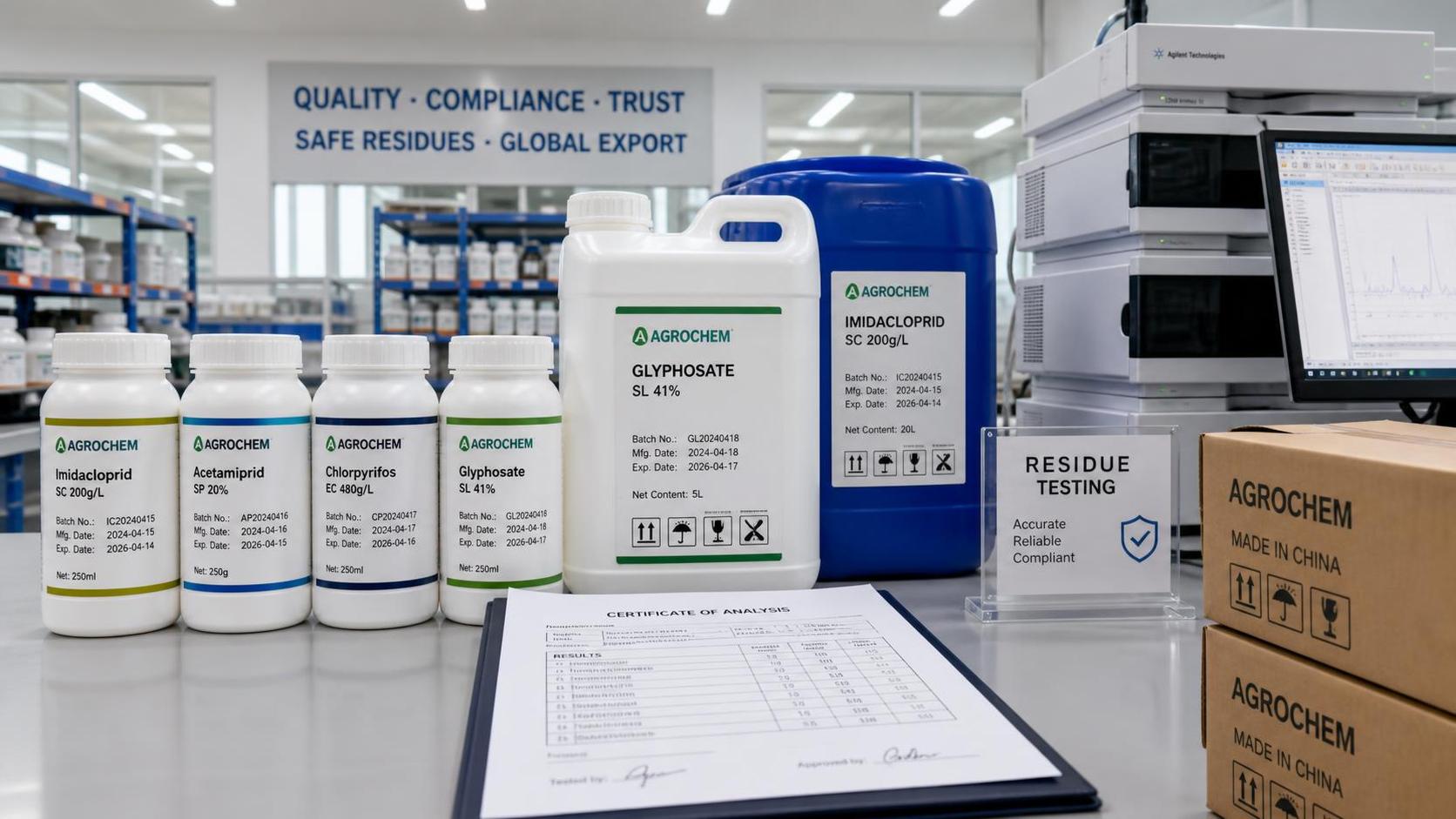
Ask for the supplier's routine certificate of analysis format, not just a sample specification table. The certificate shows what is actually tested batch by batch. Some suppliers list many parameters in marketing material but release cargo based on only a limited set of control items. If a parameter matters operationally, it should appear in the release practice or be added as a written supply condition.
Sample quality is less important than batch consistency
A polished lab sample can create false confidence. The more useful question is whether later production lots will match that sample closely enough for routine handling. Compare the supplier's manufacturing source, capacity arrangement, and batch coding logic. If the trader is sourcing from multiple plants under one product name, consistency risk rises unless there is strict harmonization of raw materials, process route, and release standard.
It is worth asking how often the manufacturing plant changes key raw material sources and whether the fungicides are produced in dedicated lines or shared equipment. Shared lines may be acceptable, but the cleaning standard, changeover procedure, and contamination controls become relevant. This is especially important where odor carryover, trace impurities, or cross-contact with other agrochemical intermediates could become a problem for downstream acceptance.
Retained sample practice also matters. If there is a future dispute, resolution becomes much easier when both sides can trace the exact batch and compare sealed retention material. A supplier that cannot clearly state retention period, labeling method, and traceability from production to export documentation introduces avoidable uncertainty.
Regulatory paperwork should be compared line by line
In cross-border chemical supply, paperwork quality can be as important as product quality. Before switching, compare the full documentation package that accompanies actual export shipments: safety data sheet, certificate of analysis, packing declaration where applicable, transport classification details, origin documentation if needed, and any product-specific declarations required by the destination country or by the receiving warehouse.
The issue is not simply whether documents exist. The issue is whether they are internally consistent and usable. Product name, grade description, CAS reference where relevant, hazard wording, packaging description, net weight, and manufacturer information should align across commercial and technical documents. Mismatched descriptions create delays during customs review, port handling, bank document checking, and local compliance screening.
Safety data sheets deserve a closer read than they usually get. Check whether the revision appears current, whether sections on handling, storage, transport, and exposure control are complete, and whether the language matches the shipment reality. An SDS copied from an old template may still contain packaging, hazard, or emergency details that no longer fit the product actually being exported.
If the destination market requires registration support or product stewardship information beyond core shipping documents, clarify the supplier's role before any switch is approved. Some suppliers can provide technical support files, composition statements, or analytical method references under controlled conditions; others cannot. That gap may not block the first shipment, but it can become a barrier when the material moves deeper into regulated channels.
Packaging is part of the product
Procurement comparisons often reduce packaging to drum size or bag type. That is too narrow. Fungicides can be sensitive to moisture ingress, liner quality, sealing integrity, headspace condition, palletization style, and stacking strength during ocean transit. A low quote can become expensive if packaging collapses in container humidity or leaks during transshipment.
Request exact packaging details: material of construction, liner specification, closure type, tamper evidence, pallet material if relevant, and whether export packaging is standardized or adjusted case by case. For liquids, drum compatibility with the formulation or solvent system should be confirmed. For solids, inner bag thickness and seal quality can be just as important as the outer bag strength.
Labeling discipline should also be compared. Poorly applied labels, unreadable batch codes, or inconsistent product naming can trigger warehouse rejection even when the cargo itself is usable. If relabeling is expected after arrival, define who bears the risk and cost if original labels are incomplete or incorrect.
Transit performance is not the same as shipping availability
A supplier may be able to ship, yet still perform weakly in actual export execution. Compare port options, lead time definition, booking reliability, dangerous goods handling capability where relevant, and the ability to provide clean pre-shipment documents early enough for review. Some supply disruptions are caused less by production and more by repeated corrections to packing lists, commercial invoices, or shipping marks.
Lead time should be broken into stages: production or stock preparation, internal quality release, packaging, booking, customs preparation, and document issuance. A quoted lead time without this structure often hides where delay is most likely. If the supplier depends on outsourced packaging or third-party warehousing, include that in the risk assessment because control over timing and lot segregation may be weaker.
Container loading practice can also influence product condition on arrival. For moisture-sensitive materials, the use of dry containers, desiccant approach if adopted, and loading inspection standards are worth clarifying. For temperature-sensitive liquid fungicides, shipment season and route may matter more than a small unit-price difference.
Compare communication under pressure, not only during quotation
Many suppliers respond quickly when business is being negotiated. The more meaningful comparison is how they handle deviation, delay, or technical challenge. Evaluate the quality of answers to specific questions: do they reply with actual batch data, process-relevant detail, and clear responsibility, or only with broad assurances? A switch becomes risky when communication is fast but content is thin.
One practical test is to raise a controlled set of detailed questions before the first order: specification tolerance logic, out-of-spec handling, document revision process, complaint response path, and shipment traceability. The way these questions are answered reveals whether the supplier has a working export system or only a sales front.
Another point is internal continuity. If all knowledge sits with one salesperson, service quality can collapse during absence or handover. It is better when technical, documentation, logistics, and commercial contacts are clearly connected and can carry the file without resetting the discussion each time.
Total cost sits in the exceptions
The unit price comparison should be rebuilt around operational reality. A lower offer may still increase total cost if it requires more incoming inspection, extra filtration, relabeling, reformulation adjustment, repacking, urgent freight corrections, or additional inventory buffer. These costs rarely appear in the initial quote, but they are exactly where supplier differences show up.
Payment terms should be read together with quality claim mechanics. If a batch arrives with a disputable issue, can claims be raised against retained samples and sealed documents, or is there no practical path except commercial negotiation? Credit terms that look favorable may matter less than a clear and enforceable batch dispute process.
Minimum order quantity and production campaign size are also part of cost. A supplier whose economics depend on large campaign runs may pressure inventory levels upward or make smaller replenishment orders unattractive. That can increase storage burden and shelf-life exposure, particularly where demand fluctuates or registrations differ across destinations.
Do not skip the compatibility conversation
Where fungicides are entering a formulation system, compatibility should be discussed before the switch is finalized. Even when the active content matches, differences in crystal habit, pH behavior, trace metal content, solvent residue, or wetting response can change milling efficiency, dispersion stability, foam profile, or final appearance. The supplier does not need to guarantee downstream performance in every system, but they should at least understand the product's processing sensitivities and be able to discuss them in technical terms.
If the material is intended for blending with other chemical raw materials in consolidated shipments, compare whether packaging dimensions, hazard segregation, and document descriptions can coexist cleanly within the same logistics plan. A supplier that handles mixed chemical exports regularly will usually be easier to work with on this point than one that only ships single-product lots.
Start with a controlled qualification path
Supplier switching is safer when the first transaction is treated as a qualification exercise rather than a routine purchase. That usually means matching the approval sample to the first commercial batch, locking the agreed specification in writing, defining document requirements before booking, and confirming packaging details before production starts. If any point remains vague at order stage, it tends to become expensive at dispatch stage.
A sensible comparison records not only whether the supplier can meet a requirement, but how clearly and repeatedly that requirement is met across specification, documents, packaging, and shipment execution. In fungicides trade, that pattern is often more predictive than a favorable first offer.
Send Us Your Inquiry Today
Luxi Chemical is a professional chemical product supplier with ample stock of all chemical categories and excellent quality, welcome your purchase inquiry.